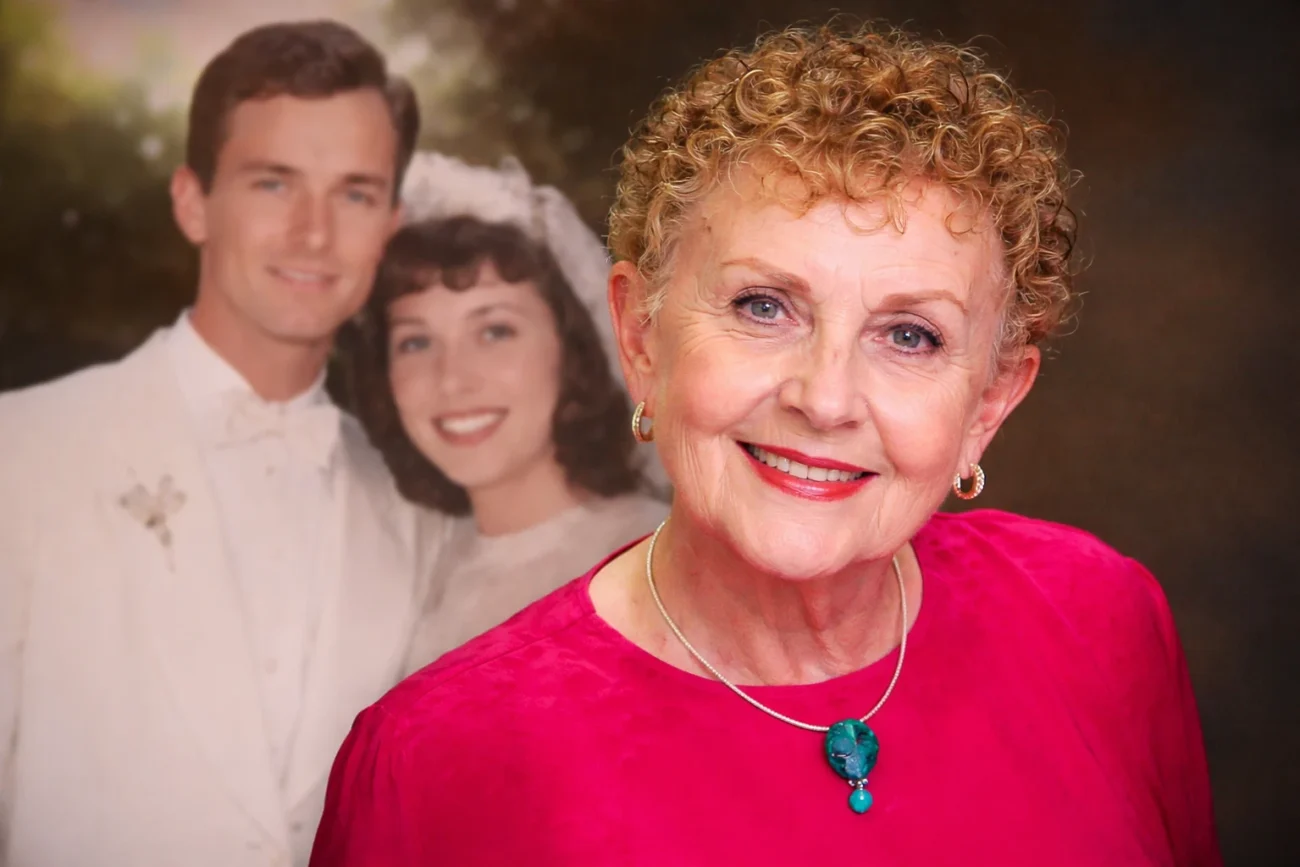
Millie Williams lived most of her life far from headlines, yet her name continues to surface in one of the most enduring stories in American pop culture. Long before Hugh Hefner became the silk-robed symbol of Playboy, he was a young man in postwar Chicago building a life with a woman he had met in high school. That woman was Mildred “Millie” Williams. Their marriage, and its unraveling, would later be woven into Hefner’s own account of how he became the man the world came to know.
For readers who search her name today, the curiosity is rarely about celebrity in the usual sense. Millie Williams was never a public figure in the way her former husband became one. Instead, she occupies a quieter, more complicated place in history: as the first wife of a media magnate, the mother of his earliest family, and a person who spent most of her life outside the spotlight that eventually surrounded him.
Early Life and Family Background
Mildred Williams was born on March 10, 1926, in Chicago, Illinois. She grew up in a Midwestern environment shaped by the economic and social realities of the Depression era, though detailed records about her early family life remain limited. Unlike her future husband, whose career and personality became the subject of extensive reporting, Williams’s upbringing was never widely documented in mainstream media.
She attended high school in Chicago, where she met Hugh Hefner. The two were part of a generation coming of age during World War II, when social expectations around marriage, work, and family were shifting but still rooted in traditional norms. Their relationship developed during these formative years, laying the groundwork for a partnership that would begin before either of them had achieved public recognition.
What’s striking about this period is how little of it has been preserved in detail. There are no extensive interviews, no memoirs, and no public record of Williams describing her own early ambitions or aspirations. The available information suggests a young woman whose life trajectory initially followed a conventional path for the time: education, marriage, and family.
Marriage to Hugh Hefner
Millie Williams married Hugh Hefner on June 25, 1949. At the time, Hefner was a recent college graduate with ambitions in writing and publishing, but he had not yet founded Playboy. Their marriage began in a modest setting, far removed from the glamour that would later define Hefner’s public image.
In later years, Hefner spoke openly about a deeply personal episode that occurred before their wedding. While he was serving in the U.S. Army, Williams had a brief affair, which she disclosed to him before they married. Hefner described this revelation as profoundly painful, often framing it as a defining moment that shaped his attitudes toward relationships and sexuality.
But here’s the thing: this account exists almost entirely through Hefner’s perspective. Williams herself did not publicly recount the event or its emotional impact. That imbalance has influenced how the story is told, turning a private matter into a widely repeated explanation for Hefner’s later lifestyle. It’s a reminder that even well-known narratives can rest on a single voice.
Despite the early strain, the marriage continued for a decade. During that time, the couple built a family and navigated the early years of Hefner’s career, including the founding of Playboy in 1953. As the magazine gained traction, the demands and pressures of Hefner’s professional life began to reshape their domestic world.
Motherhood and Family Life
Millie Williams and Hugh Hefner had two children together: Christie Ann Hefner, born in 1952, and David Paul Hefner, born in 1955. Their births marked a period when the couple was still establishing themselves, both financially and socially. The family lived in Chicago, where Hefner worked as a copywriter and later as a publisher.
Christie Hefner would go on to become a prominent figure in her own right, serving as chairman and CEO of Playboy Enterprises from 1988 to 2009. Her career created a lasting connection between Williams’s early family life and the global brand her former husband built. David Hefner, by contrast, chose a much more private path, rarely appearing in public or in media coverage.
Accounts of Williams as a mother are limited but generally respectful. Public records and family references suggest that she maintained a stable environment for her children during a period of change. That stability would become more significant after her marriage ended and she transitioned into a new phase of life.
Divorce and Its Aftermath
By 1959, Millie Williams and Hugh Hefner divorced, ending a ten-year marriage that had spanned the early rise of Playboy. The reasons for their separation were never fully detailed in public, though it’s widely understood that the growing demands of Hefner’s career and differences in lifestyle played a role.
Their divorce marked a turning point for both individuals. Hefner went on to cultivate the persona that would define him for decades, surrounding himself with the imagery and relationships that became synonymous with Playboy. Williams, on the other hand, moved in the opposite direction, choosing a life that was largely removed from public scrutiny.
Shortly after the divorce, she remarried Edwin Gunn in 1960. This second marriage introduced a new family structure, and Gunn adopted her two children. For a time, Christie and David used the surname Gunn, reflecting the stability of their mother’s new household.
Life with Edwin Gunn
Millie Williams’s marriage to Edwin Gunn marked a quieter chapter that lasted for decades. Compared to her first marriage, this period remains largely undocumented in public sources, which suggests a deliberate choice to maintain privacy. The available information indicates that she lived a relatively conventional life, raising her children and building a family outside the glare of celebrity culture.
The decision to step away from public life stands in contrast to the path taken by Hugh Hefner. While he became one of the most recognizable figures in American media, Williams appears to have prioritized personal stability and discretion. This divergence highlights two very different responses to the same shared past.
Not many people know this, but the children’s temporary use of the Gunn surname reflects the depth of that second family bond. It wasn’t simply a brief transition; it represented a period when Williams’s life was defined less by her connection to Hefner and more by her own household and relationships.
Public Appearances and Media Presence
Millie Williams made very few public appearances over the years. One of the most notable was her involvement in a 1993 episode of 60 Minutes that focused on Hugh Hefner. Even in that context, her presence was limited, reinforcing the impression that she did not seek the spotlight.
Her name has also appeared in documentaries and television retrospectives about Hefner and the history of Playboy. These appearances were typically archival or contextual rather than active participation, further underscoring her distance from the public narrative built around her former husband.
The truth is, Williams’s absence from media coverage has shaped how she is remembered. Without interviews or personal accounts, her story has often been told by others, sometimes with speculation filling the gaps. That dynamic has made it difficult to separate confirmed facts from assumptions.
Financial Life and Net Worth
There is no reliable public record of Millie Williams’s personal net worth. Many online sources offer estimates, but these figures are not supported by verifiable financial disclosures or credible reporting. As a result, any claims about her wealth should be treated with caution.
What can be said with more confidence is that her financial situation would have been influenced by her divorce settlement and her second marriage. However, the details of those arrangements have not been publicly disclosed. Unlike her former husband, whose business dealings were extensively reported, Williams’s financial life remained private.
This lack of information is consistent with the broader pattern of her life. She did not build a public career tied to her name, nor did she appear to leverage her connection to Hefner for financial visibility. Her economic story, like much of her personal life, stayed largely out of view.
Relationship to Hugh Hefner’s Legacy
Millie Williams’s place in Hugh Hefner’s legacy is both central and understated. She was part of his life before the creation of Playboy, and her marriage to him is often cited in discussions of his personal development. Yet she did not participate in the brand or its public identity.
As Hefner’s reputation has been reassessed in recent years, interest in Williams has grown. Documentaries and memoirs have prompted new questions about the people who were part of his life before and during his rise to fame. In that context, Williams is often viewed as a figure who represents a different, less public version of Hefner’s story.
That said, it’s important not to overinterpret her role. While her relationship with Hefner was significant, it does not fully explain his later actions or persona. Reducing her to a single narrative function risks oversimplifying both her life and his.
Later Years and Death
Millie Williams spent her later years largely out of the public eye. She remained in the Chicago area for much of her life, maintaining a connection to the city where she was born and where her early family life took shape. Details about her daily activities, friendships, and personal interests during these years are scarce.
Recent records indicate that she lived into her late nineties. Reports from late 2025 state that she died on December 13 at the age of 99. While the specifics of her final years have not been widely covered, the available information suggests a long life that extended well beyond the period for which she is most widely known.
Her passing received relatively limited media attention, reflecting the same pattern that defined her life. She was connected to a famous story, but she was never fully absorbed into it.
Frequently Asked Questions
Who is Millie Williams?
Millie Williams, born Mildred Williams, was the first wife of Hugh Hefner. She married him in 1949 and was part of his life before he founded Playboy. She is also the mother of Christie and David Hefner.
How long were Millie Williams and Hugh Hefner married?
They were married for ten years, from 1949 to 1959. Their marriage spanned the early stages of Hefner’s career, including the founding of Playboy in 1953.
Did Millie Williams have children?
Yes, she had two children with Hugh Hefner. Their daughter Christie became a major figure in Playboy Enterprises, while their son David has remained largely private.
What happened to Millie Williams after her divorce?
After her divorce from Hugh Hefner, she married Edwin Gunn in 1960. He adopted her children, and she lived a much quieter life compared to her former husband.
Is Millie Williams still alive?
Public records indicate that she passed away in December 2025 at the age of 99. Her death marked the end of a long life that remained mostly private.
Why is Millie Williams still talked about today?
She is often mentioned in discussions about Hugh Hefner’s early life and personal history. Renewed interest in Hefner’s legacy has led many people to revisit the individuals who were part of his life before his rise to fame.
Conclusion
Millie Williams’s story is defined as much by what is known as by what is not. She lived at the edge of a cultural phenomenon without becoming part of its spectacle. That position has made her both visible and elusive, a figure who is remembered but not fully documented.
Her life offers a contrast to the public persona of Hugh Hefner. While he built a brand that thrived on attention, Williams appears to have chosen privacy and stability. That choice shaped how her story has been told and how it continues to be understood.
There is a quiet strength in that kind of life. It does not produce headlines or headlines’ worth of detail, but it leaves behind a different kind of legacy. Millie Williams remains a reminder that not every important story is meant to be fully public.
For readers today, her life invites a more careful way of looking at history. It asks us to separate what can be proven from what has been repeated, and to respect the boundaries of a life that was never meant to be on display. That perspective may be the most meaningful part of her story.
