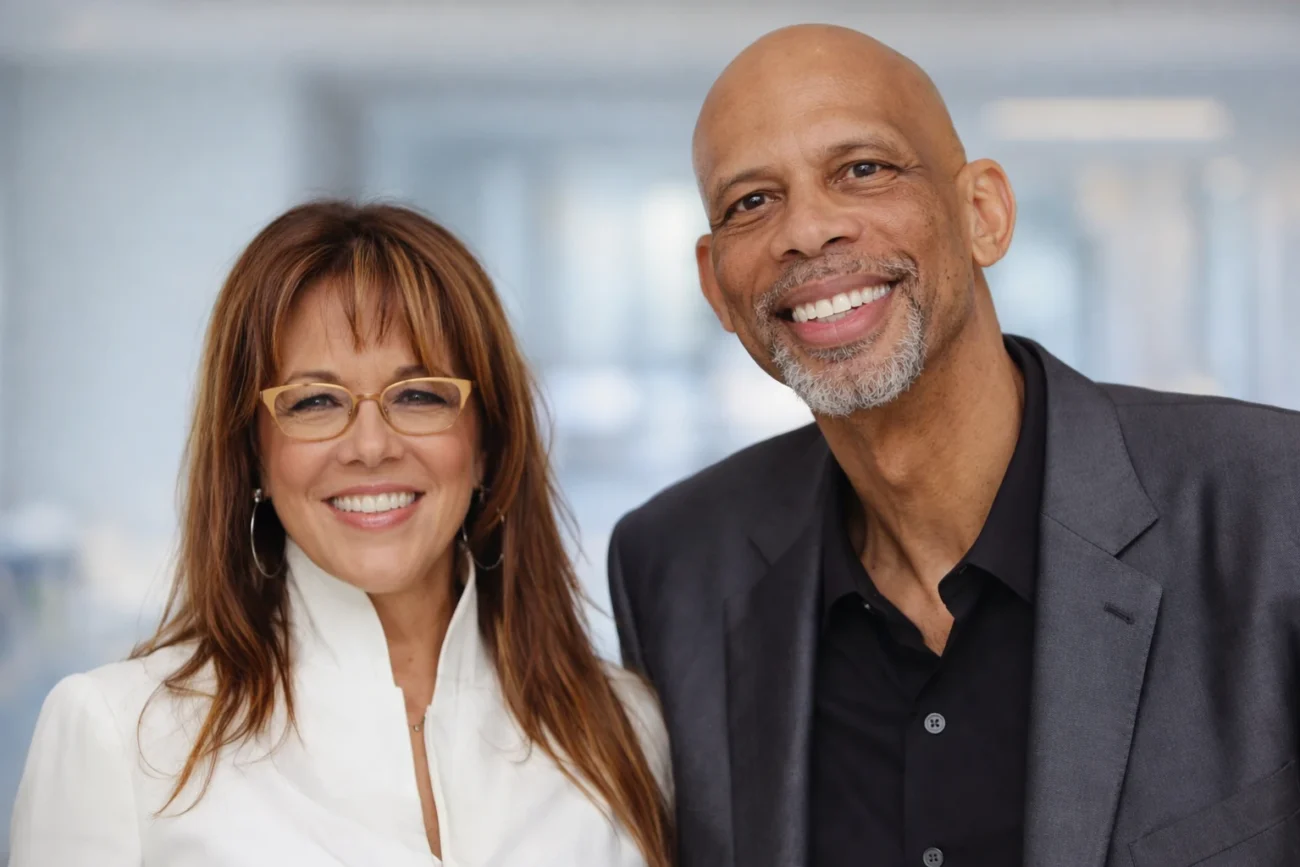
For most of the public, Cheryl Pistono exists at the edge of a larger story—a name that surfaces whenever Kareem Abdul-Jabbar’s personal life is revisited. But in the late 1970s and early 1980s, she was not a footnote. She was a central presence in the life of one of basketball’s most private and complex figures, a woman described at the time as both a partner and a force who challenged him to change. The record that remains is incomplete, sometimes contradictory, and often filtered through someone else’s fame. Still, what can be known paints a portrait of a person who mattered deeply, even if she never sought the spotlight herself.
Early Life and Family Background
Cheryl Pistono’s early years are not extensively documented, but the most reliable accounts trace her roots to LaSalle, Illinois, a small Midwestern city that stands in sharp contrast to the Hollywood-adjacent life she would later encounter. According to a 1980 Sports Illustrated profile, she left home at 16, a decision that suggests both restlessness and independence at a young age. She moved west to live with relatives, eventually attending Beverly Hills High School, where she encountered a world far removed from her upbringing.
The shift from a working-class Illinois environment to the cultural mix of Southern California appears to have shaped her outlook in lasting ways. By her own account in that same profile, she moved through social circles that included nightlife, celebrity-adjacent environments, and even connections to Hugh Hefner’s orbit. Those experiences, while often highlighted in passing, reflect a young woman testing boundaries and trying on identities in a place that encouraged reinvention.
Religion also played a role in her early development. Pistono was raised Catholic but later moved away from that background, eventually identifying with Buddhist beliefs. This spiritual transition paralleled a broader search for meaning and direction, one that would later intersect with Kareem Abdul-Jabbar’s own evolving identity. Even in the limited public record, she emerges as someone not content to simply follow a prescribed path.
Meeting Kareem Abdul-Jabbar
Cheryl Pistono met Kareem Abdul-Jabbar in 1977, during a period when he was already an established NBA star but still navigating personal transitions. At the time, Abdul-Jabbar had recently moved to Los Angeles to play for the Lakers and was living a life that combined extraordinary fame with deep isolation. Pistono, nearly a decade younger, entered that world without the usual deference expected of someone in his orbit.
What stands out in contemporaneous reporting is her initial lack of interest. She reportedly found the culture around professional athletes unappealing and did not respond to Abdul-Jabbar’s status in the way many others did. That distance may have been part of what drew him in. Their relationship began not with glamour but with persistence, small gestures, and conversations that went beyond surface-level attraction.
By 1980, when Sports Illustrated profiled Abdul-Jabbar, Pistono was 23 and living with him in Los Angeles. The article portrays their connection as intense and often challenging, marked by arguments as much as affection. She did not accept his public persona at face value and often confronted him about behavior she found inconsistent or evasive. For a man known for his guarded nature, that dynamic proved both difficult and transformative.
A Relationship That Shaped a Public Figure
The late 1970s and early 1980s were a turning point in Kareem Abdul-Jabbar’s life, both on and off the court. During that period, he became more open with the media, more expressive in interviews, and more engaged with the world beyond basketball. Several sources from the time attribute part of that change to Cheryl Pistono.
In the Sports Illustrated profile, Abdul-Jabbar is described as acknowledging her influence in unusually direct terms. He credited her with pushing him to confront personal issues he had long avoided, including unresolved aspects of his marriage and his tendency to withdraw from others. She challenged him not just emotionally but intellectually, questioning his beliefs and urging him to live more consistently with his values.
That influence was not always comfortable. Reports from the time suggest frequent disagreements, with Pistono taking a direct, sometimes confrontational approach. But those conflicts appear to have been part of a broader process that helped Abdul-Jabbar evolve during a critical phase of his career. By the early 1980s, as the Lakers began their “Showtime” era, he had become a more approachable and publicly engaged figure, even if he remained deeply private in many ways.
Their relationship also unfolded against the backdrop of Abdul-Jabbar’s marriage to Habiba Brown, which had effectively broken down by the late 1970s. The timeline of that separation and eventual divorce is not entirely straightforward, with different sources emphasizing different dates. What is clear is that Pistono was part of his life during a period of transition, and her presence coincided with significant personal change.
Family Life and Motherhood
Cheryl Pistono’s role as a mother is one of the most firmly established aspects of her public identity. She and Kareem Abdul-Jabbar had a son together, Amir Abdul-Jabbar, who was born in the early 1980s. By April 1987, a Los Angeles Times report identified Amir as six years old, placing his birth around 1980 or 1981.
Motherhood appears to have anchored Pistono’s life in ways that her earlier years did not. While details about her parenting style and daily life are limited, contemporaneous reporting suggests that she took a central role in raising Amir. Even after her relationship with Abdul-Jabbar ended, both parents seem to have maintained a cooperative approach, at least in public statements.
In that 1987 Los Angeles Times article, Pistono described her relationship with Abdul-Jabbar as “great,” emphasizing that they had made a conscious decision to prioritize their son over past conflicts. That comment stands out because it contrasts with the legal disputes and tensions reported around the same time. It suggests a deliberate effort to separate personal grievances from parental responsibilities.
Her later life also included a new marriage. By the mid-1980s, she had married Steven Jenkins, with whom she had another child. The family lived in Los Angeles, and Pistono took on the name Cheryl Pistono Jenkins. This chapter of her life is less documented than her earlier years, but it marks a clear shift toward a more private existence.
Legal Disputes and Public Tension
The mid-1980s brought a period of legal and personal conflict that briefly pulled Cheryl Pistono back into the public eye. In 1987, Kareem Abdul-Jabbar filed a lawsuit against his former business manager, Thomas Collins, alleging financial misconduct. Pistono became part of that story through her own statements and allegations.
According to the Los Angeles Times, she claimed that Collins had attempted to convince Abdul-Jabbar that Amir was not his biological son. This led to court-ordered blood tests, which, while not detailed in the article’s outcome, were presented as a significant source of stress. Pistono also accused Collins of dishonesty and manipulation, positioning herself as someone who had long distrusted his role in Abdul-Jabbar’s life.
Collins’ associates, in turn, raised questions about Pistono’s spending during the years she lived with Abdul-Jabbar, suggesting a different perspective on the relationship’s financial dynamics. The article presents these claims as part of a broader dispute, without fully resolving them. What remains clear is that the period was marked by tension, conflicting narratives, and legal complexity.
Despite that conflict, Pistono’s public comments at the time emphasize stability and forward movement. Her focus on co-parenting and maintaining a workable relationship with Abdul-Jabbar suggests a pragmatic approach to a difficult situation. Rather than prolonging public disputes, she appeared intent on closing that chapter and moving on.
Life Away from the Spotlight
After the late 1980s, Cheryl Pistono largely disappeared from public-facing media. Unlike many individuals connected to high-profile figures, she did not pursue a career in entertainment, publishing, or public speaking. Her absence from the spotlight has contributed to the scarcity of reliable information about her later life.
This lack of visibility has had an unintended consequence. In the absence of new reporting, older material has been recycled, reinterpreted, and sometimes embellished by online sources. Many modern biographies repeat the same limited facts, often adding unverified details about her age, profession, or finances. Without strong sourcing, those additions remain speculative at best.
What can be said with confidence is that Pistono chose a more private path. Her decision not to engage with media or build a public persona suggests a clear boundary between her past and her present. In an era when personal branding is often expected, that choice stands out as deliberate.
Amir Abdul-Jabbar’s Career
One of the few ways Cheryl Pistono’s story connects to the present is through her son. Amir Abdul-Jabbar has built a career far removed from the world of professional sports. He is an orthopedic surgeon and spine specialist, practicing in the United States.
His professional profile lists medical training at the University of California, San Francisco, followed by residency and fellowship programs that reflect a conventional and demanding path through medicine. This trajectory underscores a different kind of legacy, one rooted in education and professional achievement rather than public visibility.
For Pistono, Amir’s career represents a tangible outcome of her role as a parent. While she has remained out of the public eye, his accomplishments provide a glimpse into the long-term impact of her life choices. It also reinforces the idea that her story cannot be reduced to a single relationship or period of time.
Cultural Reappearance Through Television
Cheryl Pistono’s name resurfaced for a new generation through HBO’s Winning Time: The Rise of the Lakers Dynasty. The series, which dramatized the Lakers’ rise in the 1980s, included Pistono as a character, portrayed by actress Sarah Ramos. For many viewers, this was their first introduction to her.
The show presented a version of Pistono that drew from historical accounts but also took creative liberties. As with any dramatized series, the line between fact and fiction can be difficult to parse. Kareem Abdul-Jabbar himself criticized the show for inaccuracies, describing it as misleading in its portrayal of real events.
That tension highlights a broader issue with biographical storytelling. When primary sources are limited, dramatizations can quickly become the dominant narrative, shaping public perception in ways that are not always accurate. For Pistono, whose documented history is already thin, the risk of distortion is especially high.
Public Image and Lasting Impression
Cheryl Pistono’s public image has always been defined by proximity rather than self-presentation. She did not seek fame, did not cultivate a media presence, and did not leave behind a body of work that could be easily cataloged. Instead, she appears in the historical record as part of someone else’s story, albeit an important part.
What stands out in that record is her independence. From leaving home at 16 to navigating life in Los Angeles, from challenging a globally recognized athlete to building a private life afterward, she consistently made choices that resisted easy categorization. She was neither a traditional celebrity partner nor a passive figure in Abdul-Jabbar’s life.
Her influence, as described by those who knew her during that period, was direct and sometimes disruptive. She asked difficult questions, pushed for change, and refused to accept surface-level answers. Those qualities may explain why she left such a strong impression on Abdul-Jabbar, even as she stepped away from public view.
Frequently Asked Questions
Who is Cheryl Pistono?
Cheryl Pistono is best known as the former partner of NBA legend Kareem Abdul-Jabbar and the mother of his son Amir Abdul-Jabbar. She came into public view during the late 1970s and early 1980s but has since lived largely outside the spotlight. Most verified information about her comes from contemporaneous media coverage rather than recent reporting.
Was Cheryl Pistono married to Kareem Abdul-Jabbar?
No, there is no reliable evidence that Cheryl Pistono and Kareem Abdul-Jabbar were ever married. Abdul-Jabbar’s only documented marriage was to Habiba Brown. Pistono was his partner for several years but later married another man, Steven Jenkins.
Does Cheryl Pistono have children?
Yes, Cheryl Pistono has at least two children. She shares a son, Amir Abdul-Jabbar, with Kareem Abdul-Jabbar. She also had another child with her later husband, Steven Jenkins, though fewer public details are available about that side of her family.
What does Amir Abdul-Jabbar do?
Amir Abdul-Jabbar is a medical doctor specializing in orthopedic and spine surgery. He has trained at major institutions and practices in the United States. His career reflects a path focused on medicine rather than sports or entertainment.
What is Cheryl Pistono doing now?
There is very little publicly confirmed information about Cheryl Pistono’s current life. She has not maintained a public presence, and no recent interviews or official statements provide insight into her activities. This lack of information suggests she has chosen to live privately.
Why is Cheryl Pistono discussed in relation to Winning Time?
Cheryl Pistono appears as a character in HBO’s Winning Time: The Rise of the Lakers Dynasty, which dramatizes the Los Angeles Lakers of the 1980s. The series brought renewed attention to her role in Kareem Abdul-Jabbar’s life, though it should not be treated as a strictly factual account.
Conclusion
Cheryl Pistono’s story resists the tidy structure of a conventional biography. She enters the public record during a moment of transition, leaves a clear impression, and then steps away before the narrative can fully form. What remains is a collection of snapshots rather than a continuous arc.
That absence of detail is not a failure of the record so much as a reflection of her choices. She did not build a career around public attention, nor did she return to claim it later. Instead, she moved into a quieter life, one that values privacy over recognition.
Still, her impact during a crucial period in Kareem Abdul-Jabbar’s life is well documented. She was a partner who challenged, influenced, and, by multiple accounts, helped reshape one of the most iconic figures in basketball history. That role, even without a larger public profile, gives her a lasting place in that story.
For readers, the challenge is to accept the limits of what can be known while recognizing the significance of what is known. Cheryl Pistono may not fit the mold of a modern public figure, but her life, as far as it can be traced, offers a reminder that influence does not always require visibility.
