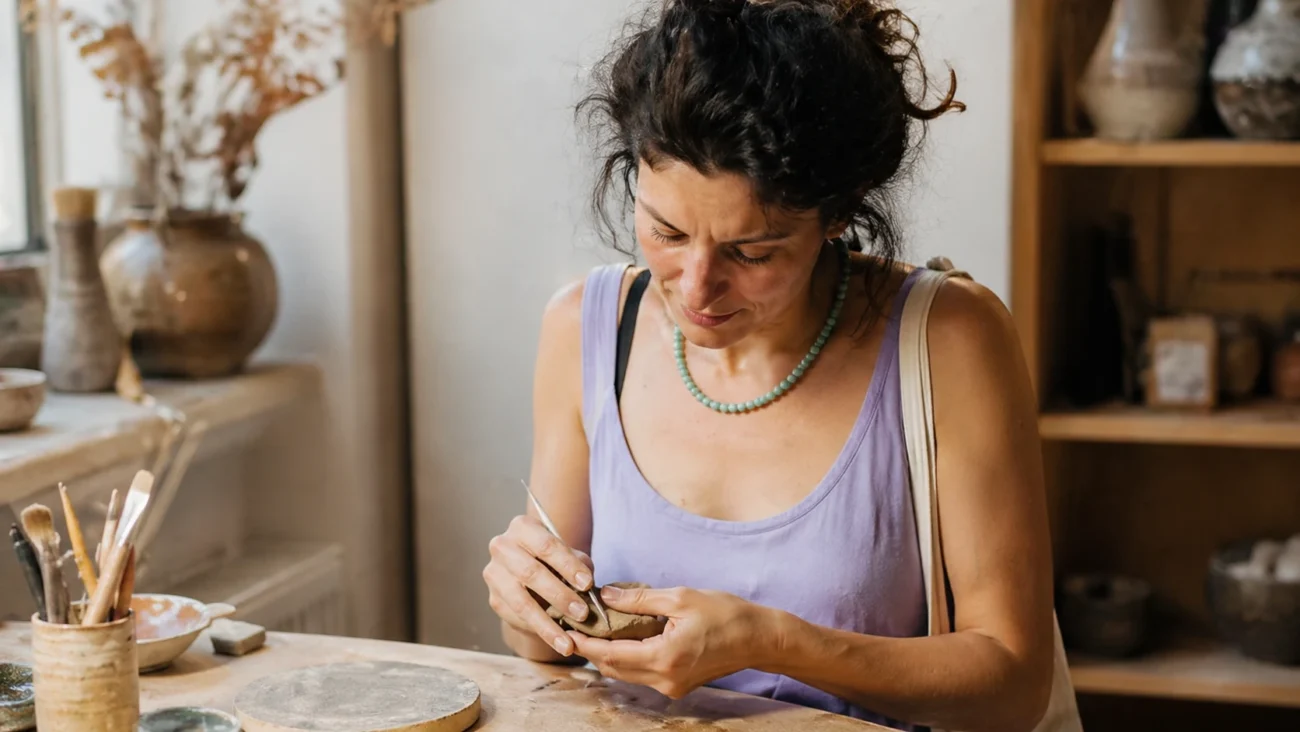
Beatrice Minns is often introduced to the public through someone else’s fame: she is married to British actor and musician Johnny Flynn. But that is only the entry point, not the substance of her story. Minns is a British artist, theatre designer, illustrator, animator, and ceramicist whose work has moved between immersive performance spaces and intimate handmade objects. Her biography is quieter than most celebrity-adjacent profiles, yet that quietness is part of what makes her interesting.
Search interest in Beatrice Minns usually begins with curiosity about Flynn’s private life, especially his wife and family. The more durable story, though, belongs to Minns herself: a trained fine artist who worked with Punchdrunk, one of the most influential immersive theatre companies in Britain, before returning to clay and building a ceramics practice from a garden studio in East London. She has not chased fame, and she has shared only a limited amount about her private life. That means the most honest biography must stay close to confirmed facts and resist turning privacy into speculation.
Early Life and Education
Public information about Beatrice Minns’ early life is limited, and there is no reliable public record confirming her exact birth date, childhood address, or detailed family background. What can be said with confidence is that her creative life began early and that making things by hand has been a long-running interest rather than a late career shift. In an interview about her ceramics, Minns has described being introduced to pottery as a child through a weekend pottery club at Camden Arts Centre. That detail matters because it connects her current work in clay to a much earlier sense of play, touch, and material discovery.
Minns later trained in fine art and specialized in painting at Winchester College of Art. That education helps explain the visual discipline visible across her later work, from theatre interiors to decorated stoneware. Painting teaches an artist to think about color, composition, surface, atmosphere, and how the eye moves across a scene. Those same skills would later translate naturally into stage environments and ceramic objects.
Her school years also connect her to Johnny Flynn. Public interviews with Flynn have said the two met at Bedales, the progressive independent school in Hampshire known for its emphasis on arts, music, and individuality. Flynn has described meeting Minns when she joined the sixth form, and their relationship began during that period. The connection did not lead immediately to a conventional lifelong path, but it became one of the defining personal relationships in both their lives.
Fine Art, Making, and First Ambitions
Minns’ early ambitions appear to have formed around art rather than public performance. Unlike Flynn, whose career placed him on stage and screen, Minns developed behind and around the visible frame. Her work has included design, illustration, animation, and object-making, all fields that require imagination but do not always put the maker in front of an audience. That distinction has shaped her public image ever since.
After Winchester, Minns built a professional identity as a designer-maker. Her American Repertory Theater biography identifies her as a London-based freelance designer-maker, illustrator, and animator, with a background in fine art. That description is useful because it shows a broad creative practice rather than one fixed job title. Minns has worked across disciplines, but the through line is making visual worlds with emotional texture.
Her artistic sensibility seems rooted in physical detail. Theatre sets, drawings, animations, and ceramics all depend on choices that reward close attention. A room can suggest memory through wallpaper, light, furniture, and dust; a ceramic shrine can do something similar through shape, glaze, and scale. Minns’ career makes sense when seen as a movement between large environments and small containers of feeling.
Work with Punchdrunk
Beatrice Minns’ most visible professional credits come through Punchdrunk, the British theatre company known for immersive productions that place audiences inside richly designed environments. Punchdrunk’s shows are not watched from a fixed seat in the usual way. Audiences walk through spaces, follow performers, discover rooms, and build their own path through the performance. That form of theatre makes design central to the audience’s experience.
Minns is credited with work connected to several major Punchdrunk productions, including Faust, The Masque of the Red Death, Tunnel 228, It Felt Like A Kiss, and Sleep No More. These credits place her within a company that changed how many theatre audiences thought about performance space. In immersive theatre, a set designer is not simply dressing a backdrop. The designer helps build a world that must hold up under direct inspection from people standing inches away.
Sleep No More is especially important in that record. The production, inspired by Macbeth and film noir, became one of the best-known immersive theatre works of the twenty-first century. Its New York home, the fictional McKittrick Hotel, ran for many years and drew international attention for its masked audiences, wordless movement, and dense design. Minns’ listed design credit connects her to a production that became a reference point for the whole field.
She was also credited as a designer on The Burnt City, Punchdrunk’s large London production inspired by the fall of Troy. That show opened in 2022 and ran in Woolwich, using large warehouse spaces to create a city-like world of myth, war, grief, and desire. Work of that scale depends on collaboration across design, choreography, sound, costume, lighting, performance, and production management. Minns’ role in such projects shows her ability to work within complex artistic teams while keeping attention on visual and physical detail.
Why Theatre Design Matters in Her Story
Theatre design is sometimes treated as background work, but in Punchdrunk’s style it becomes a form of storytelling. A visitor might enter a bedroom, a shop, an office, a temple-like chamber, or a ruined street and learn something before any performer appears. Objects carry clues. Materials create mood. The audience reads the world through texture before it understands the plot.
That kind of work requires both imagination and discipline. A designer has to think like an artist, a historian, a storyteller, and a builder at the same time. The space must look compelling, but it must also survive repeated contact from moving audiences. In immersive theatre, beauty alone is not enough; the environment has to function as a living system.
Minns’ later ceramics feel connected to that experience. Her shrine forms and small vessels also invite attention, but on a different scale. Instead of guiding someone through a warehouse, they ask a viewer to pause before a handmade object. The work becomes smaller, but the concern with memory, ritual, and atmosphere remains.
Return to Clay
After more than a decade of work as a set designer, Minns returned more fully to ceramics. Her official website describes her as working from a garden studio at her home in East London. There, she makes hand-built and thrown stoneware inspired by relics, mythology, ceremony, precious objects, memory, and nature. The language is careful and revealing because it places her work in relation to feeling as much as function.
Her ceramics are often described through shrine-like forms. These are small structures or vessels that can hold objects, mark attention, or create a personal point of focus in a room. They are not simply decorative in the usual sense, though they can be visually appealing. They suggest that ordinary homes can contain small sites of memory, gratitude, grief, or private ritual.
This return to clay also fits a broader shift in contemporary craft culture. Many people have become drawn to handmade objects because they carry evidence of touch and time. Minns’ work sits comfortably in that interest, but it does not feel like a trend exercise. The connection to childhood pottery, fine art training, and theatre design gives her ceramics a deeper backstory.
The Style of Beatrice Minns’ Ceramics
Minns’ ceramic work includes shrines, candle holders, plates, vessels, and wall pieces. Many of the forms feel small, tactile, and intimate. They often appear as objects designed to hold other objects: a flower, a shell, a stone, a charm, a photograph, or a candle. That gives them a quiet domestic purpose without reducing them to simple household goods.
Her pieces are typically described as hand-built or thrown stoneware, which suggests a practice that values both structure and irregularity. Stoneware has weight and durability, but handmade work also preserves the marks of process. A slight variation in edge, glaze, or surface can become part of the object’s character. For Minns, those variations seem aligned with the idea of memory itself, which is rarely polished or uniform.
The idea of the shrine is central to understanding her work. A shrine does not need to be grand or religious to be meaningful. It can be a small place where attention gathers around an object or thought. Minns’ ceramics invite that kind of personal use, which may explain why they have found an audience among people drawn to craft, ritual, and quiet symbolism.
Marriage to Johnny Flynn
Beatrice Minns’ marriage to Johnny Flynn is the best-known part of her public biography, but the details should be handled with care. Flynn has spoken in interviews about meeting Minns at Bedales and being drawn to her when they were young. He has also described a relationship that moved through periods of closeness and distance before settling into family life. Their story has the shape of a long personal history rather than a sudden celebrity romance.
Flynn went on to study acting and build a career as both an actor and musician. He became known for stage work, film roles, television performances, and music with Johnny Flynn & The Sussex Wit. Minns, by contrast, built a creative career that stayed largely out of the public eye. Their partnership connects two artistic lives, but only one of them has been shaped by regular media attention.
The couple have three children, a fact confirmed through public interviews and Minns’ own website. Minns’ official biography says she lives in East London with her husband and three children. Beyond that, the family has kept many details private. That privacy is not unusual for artists with children, but it is often ignored by online biography sites looking for fuller personal data than the public record provides.
Family Life and Privacy
Minns’ public life is defined as much by what she withholds as by what she shares. She does not appear to have built a public persona around her marriage, children, or domestic routines. Her website gives enough context to locate her as an artist, mother, and maker, but it does not invite strangers into the family home. That boundary deserves respect.
This privacy has sometimes created room for weak online claims. Search results often contain exact ages, net worth figures, and personal details that are not backed by strong public sources. A responsible biography should not repeat those claims as fact. If information is not confirmed by Minns, Flynn, a reputable interview, or a professional record, it belongs in the category of unverified material.
Her approach also says something about the kind of public figure she is. Minns is not invisible, but she is selective. Her work can be found, her theatre credits can be traced, and her ceramics can be viewed through official channels. What she has not done is convert personal life into a public product.
Money, Income Sources, and Net Worth
There is no credible public record confirming Beatrice Minns’ net worth. Some websites publish estimated figures, but those numbers are not supported by reliable financial reporting, public filings, or direct statements from Minns. For that reason, any exact claim about her wealth should be treated as speculation. A fact-based profile can discuss likely income sources, but it should not pretend to know private finances.
Her known income sources appear to include work in theatre design, freelance creative practice, and ceramics sales. Her official shop has listed handmade pieces such as shrines, candle holders, and plates, with some small works priced in the tens of pounds and larger pieces higher. Those shop prices give a sense of her direct-to-buyer ceramics practice, but they do not reveal annual income. They also do not account for commissions, design work, production fees, stockists, or other private arrangements.
The same caution applies to Flynn’s public career and family wealth. A spouse’s fame does not provide a reliable calculation of Minns’ personal finances. Creative households often draw income from several streams, including performance work, royalties, commissions, teaching, design contracts, and sales. Without verified records, the honest answer is that Minns’ net worth is not publicly known.
Public Image
Beatrice Minns’ public image is unusually restrained for someone connected to a well-known actor. She is not a celebrity spouse in the familiar social-media sense. She is better understood as a working artist whose name appears in theatre credits, shop listings, and occasional interviews. That gives her a public presence, but not a public performance of self.
This restraint may be one reason readers remain curious about her. People often search more when information is scarce, especially when someone is connected to a familiar actor. Yet the lack of constant visibility should not be mistaken for mystery or secrecy. It may simply reflect a person who values work, family, and privacy over public attention.
Her image also benefits from the nature of her work. Ceramics, theatre design, and illustration create an impression of someone concerned with making rather than display. That does not make her life more virtuous than a public-facing career, but it does make her public footprint feel different. She appears through objects, spaces, and credits more than through interviews, headlines, or personal branding.
Where Beatrice Minns Is Now
Beatrice Minns is currently understood to be based in East London, where she works from a garden studio and continues her ceramics practice. Her official materials describe a life built around home, family, and making. The studio setting is not a glamorous public image, but it is a fitting one for an artist whose recent work depends on hand, clay, firing, and close attention. It gives a clear picture of a creative life organized around process.
Her current work remains tied to small-batch handmade ceramics. Pieces may appear through her own shop and related channels, though availability can change because handmade work is limited by time, labor, and firing cycles. Buyers interested in her work are best served by checking official sources rather than relying on resale listings or copied product images. Small ceramics are easy to misattribute, especially when an artist’s name becomes searchable for reasons beyond the work itself.
Minns’ wider public status is likely to remain tied to two stories at once. One is her own career as an artist and designer. The other is her family connection to Johnny Flynn, whose film, television, theatre, and music work keeps him in the public eye. The fairest account allows both stories to exist without letting either erase the other.
Frequently Asked Questions
Who is Beatrice Minns?
Beatrice Minns is a British artist, designer, and ceramicist based in East London. She trained in fine art, specialized in painting, worked in theatre design, and has public credits connected to Punchdrunk productions. She is also widely known as the wife of actor and musician Johnny Flynn.
Her current public work focuses on handmade ceramics, especially stoneware shrines, vessels, candle holders, and small objects connected to memory and ritual. She works from a garden studio at home and has described her practice through themes such as relics, mythology, ceremony, nature, and precious objects. Her career is best understood as a long creative path rather than a simple celebrity association.
Is Beatrice Minns married to Johnny Flynn?
Yes, Beatrice Minns is married to Johnny Flynn. The two have known each other since their school years at Bedales, and Flynn has spoken publicly about their long relationship. Their marriage is often the reason many readers first search for Minns, especially when Flynn appears in a new film, television series, or music project.
The couple have three children and are understood to live in East London. Minns has kept most family details private, and responsible profiles should not overstate what is publicly known. Their relationship is part of her biography, but it is not the whole of it.
What does Beatrice Minns do?
Beatrice Minns is an artist and maker whose work has included set design, illustration, animation, and ceramics. Her best-known professional theatre credits are linked to Punchdrunk, the immersive theatre company behind productions such as Sleep No More and The Burnt City. In those contexts, she worked in design, helping create spaces that audiences could move through and experience directly.
Today, her most visible work is ceramics. She makes hand-built and thrown stoneware, with a focus on pieces that feel personal, symbolic, and connected to memory. Her ceramics are often sold in small batches, which means availability can be limited.
What is Beatrice Minns’ age?
Beatrice Minns’ exact age is not confirmed in the most reliable public sources. Some websites publish an age or birth year, but many of those claims are unsourced and should not be treated as verified. Her own public materials do not appear to give a birth date.
What is confirmed is that she and Johnny Flynn met during their school years at Bedales. That provides a broad life-stage context, but it does not establish a precise date of birth. A careful biography should avoid guessing where the public record is unclear.
What is Beatrice Minns’ net worth?
Beatrice Minns’ net worth is not publicly confirmed. Online estimates exist, but they do not appear to be based on credible financial records or direct reporting. Because of that, exact figures should be treated as guesswork rather than fact.
Her income likely comes from creative work, including theatre design, freelance art practice, and ceramics sales. Her handmade pieces have been sold through official channels, but product prices do not reveal total earnings. Without verified financial information, the most accurate answer is that her net worth remains private.
Did Beatrice Minns work on Sleep No More?
Yes, Beatrice Minns has been credited in connection with Sleep No More, the famous immersive production associated with Punchdrunk. The production became one of the defining works of modern immersive theatre and ran for many years in New York. Its success helped bring wider attention to theatre that audiences experience by moving through detailed environments.
That credit is important because it shows Minns’ place in a serious professional theatre context. Sleep No More was not a small side project; it was a major production with international influence. Her involvement strengthens the case for viewing her as a significant creative worker in her own right.
Where does Beatrice Minns live now?
Beatrice Minns is publicly described as living in East London with her husband and three children. Her official biography says she works from a garden studio at home. That studio is where she makes her ceramics and continues the creative practice she has built after years in set design.
More specific home details are not public and should remain private. For readers, the important point is that her current life appears centered on family, studio work, and small-scale making. That fits the public record of someone who has chosen a creative life without turning private space into public spectacle.
Conclusion
Beatrice Minns’ story is not the kind that can be told through red carpets, scandals, or a long trail of interviews. It is quieter and more material than that. She has moved from fine art training into immersive theatre design and then into a ceramics practice shaped by memory, ritual, and handmade form. Her life is public enough to trace, but private enough to require care.
That care is the key to understanding her. Minns is married to Johnny Flynn, and that relationship explains much of the search interest in her name. But the record also shows an artist with her own body of work, her own creative history, and her own reasons for staying away from constant public attention. Reducing her to a famous spouse misses the stronger story.
Her ceramics offer the most fitting image of where she stands now. They are small objects made for attention, holding, and meaning. In a culture that often rewards noise, Beatrice Minns has built a public identity through quieter forms of presence. That may be why people keep searching for her, and why the most respectful answer begins with the work.
