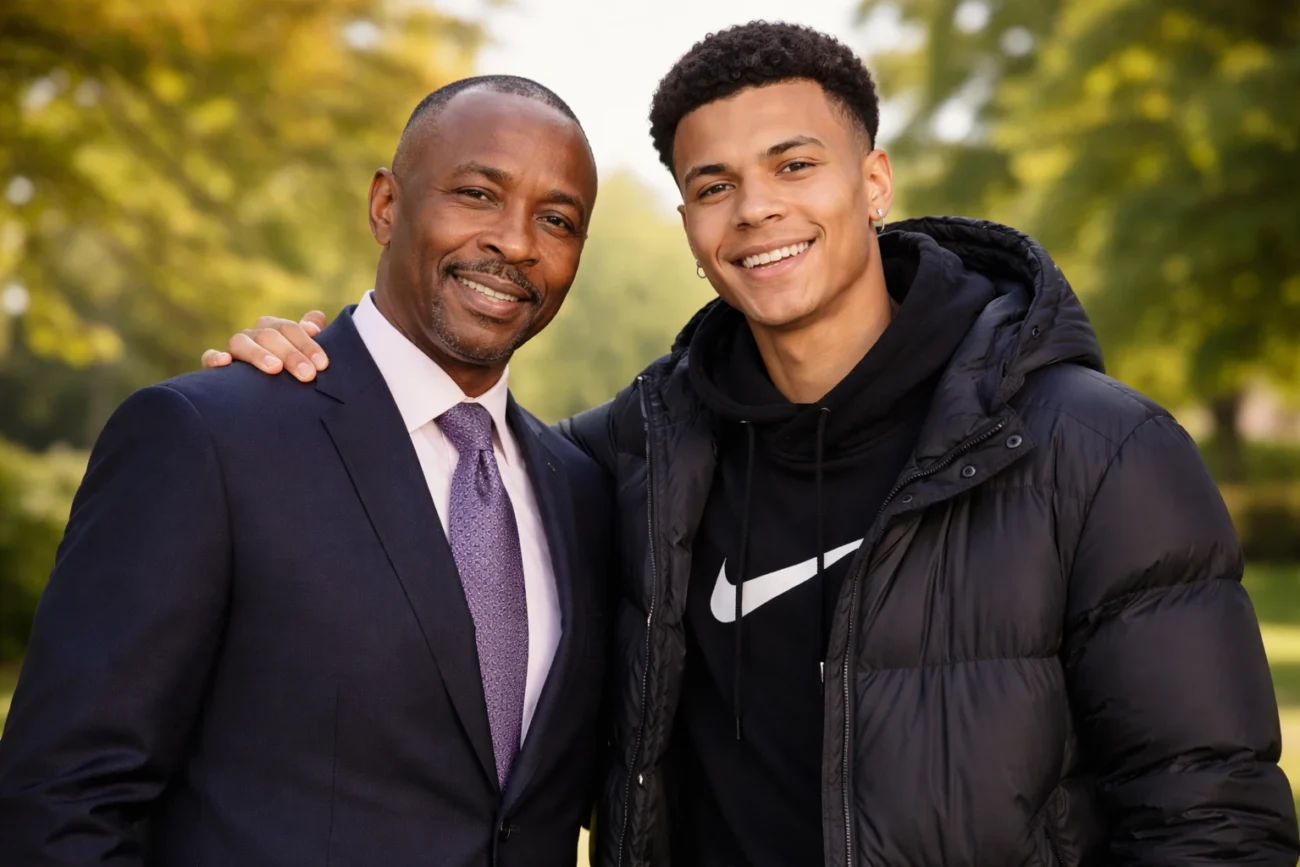
In modern football, where players’ lives are dissected as closely as their performances, some names surface not because of their own public careers, but because of their connection to someone in the spotlight. Kehinde Alli is one of those names. He is best known as the father of English footballer Dele Alli, yet remains a largely private figure whose life has been pulled into public conversation through his son’s rise, struggles, and deeply personal revelations.
For many readers, the interest in Kehinde Alli begins with a simple question: who is he, beyond the headlines and fragmented online profiles? The answer is more complicated than the internet often suggests. Unlike celebrities or public figures with well-documented careers, Kehinde Alli exists in the public record only in fragments—some confirmed, others repeated without clear sourcing. What emerges is not a complete biography, but a partial portrait shaped by family history, migration, and the emotional weight of a father-son relationship that has been both distant and difficult.
This is a story about what is known, what is often claimed, and what remains uncertain.
Early Life and Background
Kehinde Alli is widely described as a Nigerian man of Yoruba heritage, though specific details about his birth date, upbringing, and early life are not well documented in reliable public sources. The Yoruba are one of Nigeria’s largest ethnic groups, with a long history of cultural influence across West Africa. His name itself, “Kehinde,” is traditionally given to the second-born twin in Yoruba culture, which suggests a cultural identity rooted in that tradition, even if personal details about his childhood remain private.
What can be said with confidence is that Kehinde Alli came from Nigeria and later spent time abroad, including in the United States and the United Kingdom. This pattern of movement reflects a broader trend among Nigerians who pursued opportunities overseas during the late twentieth century. However, beyond this general context, there is little verified information about his education, professional training, or early ambitions.
That absence of detail is important. Many online biographies attempt to fill in these gaps with precise claims about schools, careers, and achievements, but most of those claims are not backed by verifiable records. As a result, any account of Kehinde Alli’s early life must remain cautious and grounded in what can be confirmed rather than what is repeated.
Relationship with Dele Alli’s Mother
Kehinde Alli’s most documented personal relationship is with Denise Alli, an English woman from Milton Keynes. Their relationship led to the birth of their son, Bamidele Jermaine Alli—known to the world as Dele Alli—on April 11, 1996. At the time, Denise was in England, and Dele was born there, giving him British nationality.
According to widely reported accounts of Dele’s early life, Kehinde left England shortly after his son’s birth, relocating to the United States. The reasons for that move have not been publicly detailed in a consistent or well-documented way. What is clear is that the decision created physical distance between father and son at a very early stage.
Denise remained in England with Dele, but her own life was marked by challenges that have been discussed in later interviews. Dele has described his early childhood as unstable, a period shaped by limited supervision and difficult circumstances. In this context, Kehinde’s absence became part of a larger picture of a fragmented family environment rather than a single defining factor on its own.
Dele Alli’s Childhood and Time in Nigeria
One of the few confirmed aspects of Kehinde Alli’s involvement in his son’s life comes from the period when Dele was sent to Nigeria as a child. Reliable accounts state that Dele spent approximately two years living with his father there before returning to England. This period has been referenced in multiple profiles of Dele’s upbringing and later in his own public statements.
What’s surprising is how little detail exists about those years beyond their duration and general location. There are no widely cited interviews from Kehinde himself describing that time, nor is there extensive third-party reporting that reconstructs daily life during those years. Much of what the public understands comes from Dele’s retrospective account.
In a 2023 interview, Dele described his time in Africa as difficult and emotionally challenging. He spoke about feeling disconnected and unhappy, adding another layer to the narrative of a childhood marked by instability. At the same time, reactions from extended family members in Nigeria suggested that not everyone agrees with his portrayal, highlighting how family histories can become contested once they are discussed publicly.
The truth likely sits in a space shaped by personal experience, memory, and differing perspectives. Without independent documentation, it is not possible to reconstruct that period in full detail. What can be said is that it was significant enough to remain a central part of Dele’s story years later.
A Shift in Guardianship
By the time Dele reached his teenage years, his living situation had changed again. At age 13, he moved into the home of Alan and Sally Hickford, a couple who would become central figures in his life. Though they never legally adopted him, Dele has often referred to them as his adoptive parents.
This shift marked a turning point. Under the Hickfords’ care, Dele found a more stable environment, one that allowed him to focus on football and personal development. His progress as a player accelerated during this period, eventually leading to his breakthrough with MK Dons and later his high-profile move to Tottenham Hotspur.
For Kehinde Alli, this stage of his son’s life appears to have been more distant. Public records do not show regular involvement, and Dele’s own comments suggest that their relationship had already become strained. The absence of detailed reporting about any ongoing contact reinforces the impression of a father-son relationship that had largely fractured by this point.
The Name Change That Drew Attention
In 2016, during his early years at Tottenham Hotspur, Dele made a decision that brought renewed attention to his family background. He chose to wear “Dele” on the back of his shirt instead of “Alli.” At the time, he explained that the choice reflected his personal identity and his connection to the people who had supported him.
He stated publicly that he felt no strong connection to the surname Alli, a comment that resonated widely. For many fans, it was a rare glimpse into the emotional realities behind a professional athlete’s public image. For others, it raised questions about his relationship with his biological parents, including Kehinde.
The moment did not provide a detailed explanation of their relationship, but it made clear that the distance was not just physical or circumstantial. It was emotional and deeply felt. From that point forward, Kehinde Alli’s name became part of a broader conversation about identity, belonging, and family ties.
Public Attention After 2023
Interest in Kehinde Alli surged again in July 2023, when Dele gave a candid interview discussing his childhood and personal struggles. In that conversation, he spoke openly about trauma, addiction, and his relationship with his biological parents. He said he felt betrayed by them and confirmed that he no longer maintained contact.
The interview was widely covered and sparked conversations about mental health, safeguarding in childhood, and the pressures faced by young athletes. It also brought renewed scrutiny to the figures mentioned in his story, including Kehinde.
That said, it is important to separate Dele’s account from a complete biography of his father. The interview provided insight into Dele’s experience, but it did not offer a full, independently verified portrait of Kehinde Alli’s life or perspective. The absence of public statements from Kehinde himself means that his side of the story remains largely unknown.
Career and Financial Background: What Is Known
Perhaps the most contested area of Kehinde Alli’s biography is his professional life. Numerous websites describe him as a businessman involved in industries ranging from oil and gas to information technology. Some claim he has held executive roles or managed international ventures, while others suggest he has built significant wealth.
The problem is that these claims are rarely supported by verifiable evidence such as corporate filings, major media profiles, or interviews. They often appear in articles that cite each other rather than independent sources. This makes it difficult to confirm even basic details about his career trajectory.
It is entirely possible that Kehinde Alli has had a successful professional life outside public view. Many individuals operate businesses or careers that never attract media attention. But without reliable documentation, any specific claims about his work or net worth should be treated as unconfirmed. Estimates of wealth, when mentioned online, are speculative and should not be presented as established fact.
Public Image and Media Representation
Kehinde Alli’s public image is shaped less by his own actions than by how he appears in narratives about his son. This creates a somewhat distorted picture, where he is known primarily through absence or conflict rather than through direct public engagement.
Media coverage has tended to focus on Dele’s experiences, particularly when discussing his childhood. As a result, Kehinde is often referenced rather than profiled. This kind of second-hand visibility can flatten a person’s identity, reducing them to a role within someone else’s story.
There is also a broader issue at play. In the age of search-driven content, individuals connected to public figures often become subjects of rapid, loosely sourced biography writing. Kehinde Alli’s case reflects this pattern, where the demand for information outpaces the availability of reliable data.
Current Status and Where He Is Now
As of recent years, there is no widely confirmed public record detailing Kehinde Alli’s current location or activities. He is believed to have spent time in both Nigeria and the United States, but specific details about where he lives today are not clearly established in reliable sources.
There have been no major public interviews, official statements, or widely reported appearances that provide insight into his current life. This lack of visibility reinforces the understanding that he remains a private individual despite ongoing public curiosity.
For readers, this can feel like an incomplete ending. But it also reflects a reality that is often overlooked: not everyone connected to fame chooses or achieves public presence. Some remain outside the spotlight, even when their names continue to circulate within it.
Frequently Asked Questions
Who is Kehinde Alli?
Kehinde Alli is best known as the father of English footballer Dele Alli. He is of Nigerian Yoruba heritage and has been mentioned in accounts of Dele’s early life, but he is not a widely documented public figure in his own right.
What is Kehinde Alli’s nationality?
He is Nigerian by origin. His background is linked to the Yoruba ethnic group, and he has spent time both in Nigeria and abroad, including in the United States.
What does Kehinde Alli do for a living?
There are many online claims describing him as a businessman, but there is limited verifiable evidence to confirm specific roles or industries. As a result, his professional career remains largely unconfirmed in reliable public sources.
What is Kehinde Alli’s relationship with Dele Alli?
Dele Alli has publicly stated that he has no current relationship with his biological parents, including his father. Their relationship has been described as distant and strained, particularly in Dele’s own accounts.
Why did Dele Alli drop the surname “Alli”?
In 2016, Dele chose to use his first name on his football shirt, explaining that he felt no strong connection to the surname. The decision reflected his personal identity and his relationship with his family.
Where is Kehinde Alli now?
There is no confirmed public information about his current location or activities. He is believed to have lived in Nigeria and the United States, but his present circumstances are not clearly documented.
Conclusion
Kehinde Alli’s story is unusual not because it is fully told, but because it is not. In an era when information is expected to be instant and complete, his biography remains partial, shaped by what can be confirmed and what cannot. He is known, but not fully understood.
Much of the public interest in his life comes from his connection to Dele Alli, a footballer whose journey has been both celebrated and scrutinized. Through that connection, Kehinde’s name has become part of a larger narrative about family, identity, and the long shadow of childhood experiences.
What remains is a reminder that not every life connected to fame is documented in detail. Some stories stay incomplete, defined as much by silence as by what is said. Kehinde Alli’s biography, as it stands, is one of those stories—a portrait drawn in outline, with much of the detail still out of view.
For readers, the most honest approach is to accept that boundary. To understand what is known, question what is not, and recognize that behind every public story lies a private life that may never be fully told.
