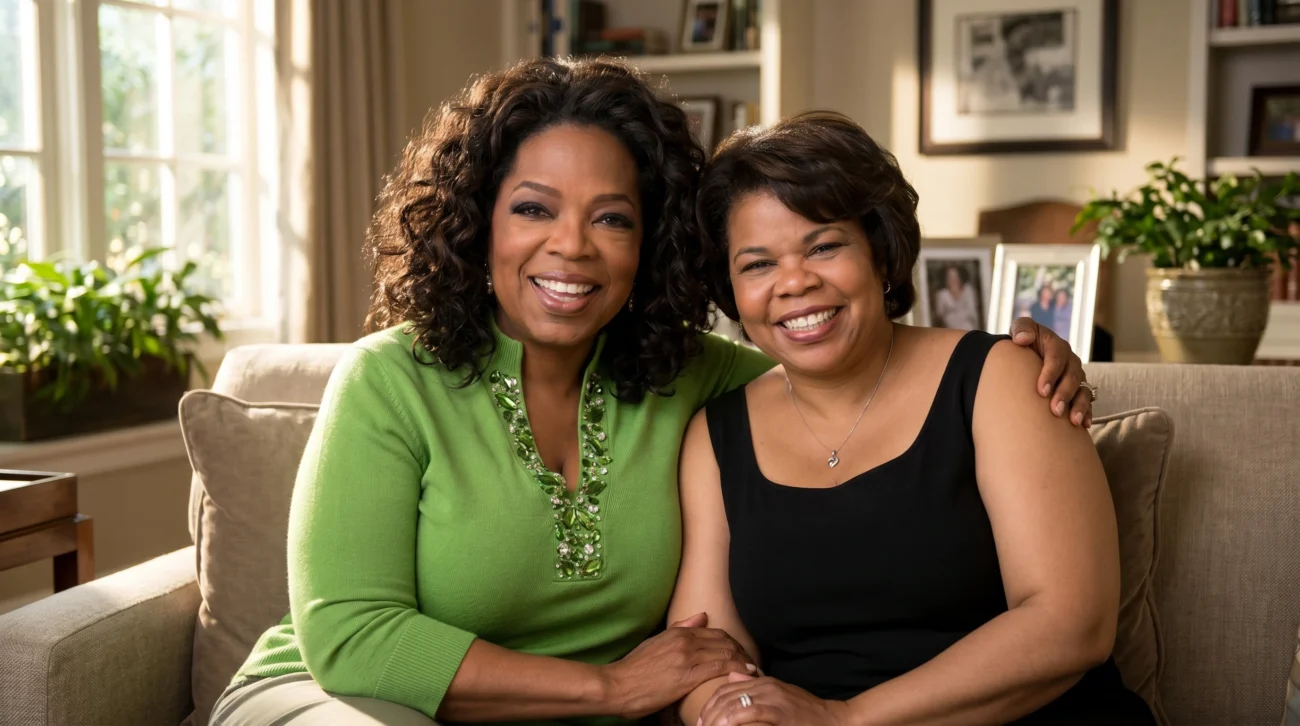
For years, Patricia Lofton lived with a question that many adoptees quietly carry: who am I, and where do I come from? The answer, when it finally arrived, would connect her to one of the most recognizable figures in modern media. But the story of Patricia Lofton is not simply about a famous family link. It is about a life shaped by separation, resilience, and the long, patient search for identity in a world that rarely pauses for such deeply personal journeys.
Most people encounter Patricia Lofton’s name through her connection to Oprah Winfrey. Yet reducing her to that single fact misses the quieter, more human narrative that has unfolded across decades. Her life reflects the experience of thousands of adoptees navigating foster care, fragmented beginnings, and the complicated process of reclaiming a personal history that was never fully theirs to begin with.
Early Life and Family Background
Patricia Lofton was born on April 26, 1963, in Milwaukee, Wisconsin, to Vernita Lee. At the time, Lee was already struggling to support her family, and like many women facing economic hardship in the early 1960s, she made the difficult decision to place her newborn daughter for adoption. That decision would shape the course of Patricia’s life in ways neither mother nor child could fully anticipate.
Unlike many adoption stories that end with a stable home, Patricia’s early years were marked by uncertainty. She spent time in foster care, moving between different households before eventually being adopted at the age of seven. Those formative years, spent without a clear sense of permanence, left a lasting impression. They also instilled in her a sensitivity to the experiences of other children in similar circumstances.
The truth is, growing up in foster care often means learning to adapt quickly, to read people carefully, and to manage expectations about belonging. Patricia’s later reflections suggest she carried both the emotional weight and the strength that came from that upbringing. She would eventually speak about hoping, as a child, that her birth mother might return for her—a hope that faded with time but never entirely disappeared.
Growing Up Without Answers
For much of her life, Patricia Lofton had only fragments of information about her origins. Adoption records in mid-20th-century America were often sealed, leaving adoptees with limited access to their own histories. That lack of information can create a persistent sense of incompleteness, and Patricia’s experience was no exception.
As she grew older, she built a life that was largely private and grounded in everyday responsibilities. Public records about her adult years remain limited, and that scarcity is important to acknowledge. Unlike public figures who cultivate visibility, Patricia did not spend decades in the spotlight, and much of her life unfolded away from media attention.
But here’s where it gets interesting. The absence of detailed public documentation does not mean her life lacked direction or meaning. Instead, it reflects a person who navigated adulthood without the external markers of fame or notoriety, focusing instead on family, work, and personal stability. That quiet existence would eventually intersect with a much larger public story, but only after years of unanswered questions.
The Search for Her Roots
The turning point in Patricia Lofton’s life came when she decided to pursue answers about her birth family. Encouraged in part by her own children, she requested access to her adoption records in 2007. What she found did not immediately provide clarity, but it offered enough clues to begin connecting the dots.
Those records indicated that she had biological siblings, though they did not name them. For many adoptees, that kind of partial information can be both hopeful and frustrating. It suggests a path forward but leaves the most important details just out of reach. Patricia began to investigate further, piecing together what she could from available information.
Her search took on new urgency after she saw a television interview featuring Vernita Lee, Oprah Winfrey’s mother. In that interview, Lee spoke about the loss of two of her children. Something about the details resonated with Patricia, prompting her to consider the possibility that this family might be her own. It was a moment that required both courage and restraint, as she weighed the implications of pursuing such a connection.
Discovering the Truth
Patricia’s path to confirmation was careful and deliberate. Rather than going public with her suspicions, she sought to establish the truth privately. She eventually made contact with members of the extended Winfrey family, including Oprah’s niece. The resemblance between Patricia and her biological relatives reportedly added to the growing sense that her suspicions were correct.
A DNA test ultimately confirmed what Patricia had begun to suspect: she was indeed the biological daughter of Vernita Lee and the half-sister of Oprah Winfrey. The discovery was as profound as it was unexpected. For Patricia, it answered questions that had lingered for decades. For Oprah, it revealed a family connection she had never known existed.
What stands out in accounts of this period is Patricia’s discretion. She did not approach the media, nor did she attempt to leverage the connection for personal gain. Instead, she allowed the process to unfold within the family. That decision would later be recognized as a defining aspect of her character.
The Public Revelation in 2011
In January 2011, Oprah Winfrey chose to share the story publicly on her talk show. The announcement was framed not as a sensational revelation, but as a deeply personal family discovery. Oprah described learning about Patricia only a few months earlier, calling it a shocking but ultimately meaningful experience.
The broadcast introduced Patricia Lofton to a global audience almost overnight. For viewers, the story carried emotional weight because it intersected with themes already familiar in Oprah’s public narrative: family hardship, resilience, and the search for connection. Patricia’s presence added a new dimension to that story, one that emphasized reunion rather than loss.
Oprah spoke openly about why she embraced Patricia. She highlighted her half-sister’s decision to remain private during the search process, describing it as a sign of integrity. That framing shaped public perception from the outset, positioning Patricia not as a disruptor, but as someone who approached a sensitive situation with care and respect.
Building a Relationship
After the public reveal, Patricia and Oprah began the process of building a relationship. That process, by Oprah’s own account, was gradual and grounded in mutual understanding. They were not simply reconnecting; they were getting to know each other for the first time.
Family dynamics can be complex even under ordinary circumstances. In this case, the added layer of public attention made the process more challenging. Yet both women appeared committed to navigating it with patience. Reports in the years following the reunion suggest that their bond grew stronger over time, supported by shared experiences and a willingness to move forward together.
The broader family context also played a role. Oprah had previously lost two siblings, and Patricia’s arrival brought both joy and a sense of emotional healing. For other family members, the reunion offered an opportunity to reconnect with a part of their history that had been missing.
Education and Personal Goals
One of the most concrete developments in Patricia Lofton’s life after the reunion was her return to education. In her 50s, she enrolled at the University of Wisconsin-Milwaukee, pursuing a degree in sociology. That decision reflected both personal ambition and a desire to give back, particularly to children in foster care.
Returning to college later in life is no small undertaking. It requires discipline, resilience, and a willingness to step outside familiar routines. Patricia’s success in completing her degree in 2017, at the age of 54, stands as a significant achievement. It also aligns with her stated interest in helping others who share aspects of her early life experience.
Her focus on sociology suggests a deeper engagement with the systems that shaped her childhood. By studying those systems, she positioned herself to contribute in a meaningful way, whether through advocacy, mentorship, or community work. While detailed accounts of her professional activities remain limited, the educational milestone itself speaks to her determination.
Public Image and Media Coverage
Patricia Lofton’s public image has been shaped largely by her association with Oprah Winfrey, but it has also been defined by what she has chosen not to do. In an era where personal stories are often monetized, her decision to maintain a relatively low profile stands out.
Media coverage of Patricia has generally been respectful, focusing on the human aspects of her story rather than sensational details. That tone reflects both the nature of the narrative and the way it was introduced to the public. Oprah’s framing of the reunion as a family matter set expectations that have largely been upheld.
At the same time, the internet has generated a parallel layer of content that is less reliable. Many websites attempt to construct a fuller biography by adding unverified details about Patricia’s career, finances, and personal life. These accounts often lack credible sourcing, highlighting the importance of distinguishing between established facts and speculative additions.
Personal Life and Privacy
Details about Patricia Lofton’s personal life remain limited, and that is by design. She has not sought public attention beyond what came with her family connection, and she has maintained a level of privacy that is increasingly rare. Information about her relationships, children, and day-to-day activities is not widely documented in credible sources.
That lack of visibility can be frustrating for readers seeking a complete picture, but it also reflects a deliberate choice. Patricia’s story is not one of self-promotion, and her decision to keep certain aspects of her life private deserves respect. It also serves as a reminder that not every compelling narrative needs to be fully exposed to public view.
What is known suggests a life centered on family and personal growth rather than public recognition. Her actions following the reunion—particularly her return to education—indicate a focus on long-term goals rather than short-term visibility.
Financial Status and Net Worth
There is no publicly verified information about Patricia Lofton’s net worth. While some online sources attempt to estimate her financial status, these figures are speculative and should be treated with caution. Unlike public figures who disclose earnings through business ventures or media contracts, Patricia’s financial details are not part of the public record.
It is reasonable to assume that her life changed in practical ways after reconnecting with Oprah Winfrey, but any claims beyond that remain unconfirmed. Responsible reporting requires acknowledging those limits rather than filling them with conjecture.
Where Patricia Lofton Is Now
In recent years, Patricia Lofton has continued to live a largely private life. Public appearances are rare, and there is little verified information about her current activities. What can be said with confidence is that she remains part of the Winfrey family and that her relationship with Oprah has endured beyond the initial reunion.
Her educational achievement and expressed interest in helping foster children suggest ongoing engagement with community-focused work. However, without detailed reporting, it is difficult to draw firm conclusions about her current role or projects. That uncertainty is not unusual for someone who has chosen to stay out of the spotlight.
The truth is, Patricia’s present-day life reflects the same balance that has defined her story from the beginning: a connection to something widely known, paired with a personal path that remains largely her own.
Frequently Asked Questions
Who is Patricia Lofton?
Patricia Lofton is widely understood to be Oprah Winfrey’s half-sister, born to Vernita Lee in 1963 and placed for adoption at birth. She became publicly known after Oprah revealed their relationship in 2011. Her story is closely tied to that family connection, though much of her life has been lived privately.
How did Patricia Lofton meet Oprah Winfrey?
Patricia Lofton did not meet Oprah until adulthood. After researching her adoption records and identifying possible family connections, she reached out to members of the Winfrey family. A DNA test confirmed the relationship, leading to their eventual meeting and public introduction.
What is Patricia Lofton known for?
She is best known for being Oprah Winfrey’s half-sister and for the widely publicized reunion that took place in 2011. Beyond that, she is recognized for her personal journey through foster care and adoption, as well as her later educational achievements.
What does Patricia Lofton do for a living?
There is no widely confirmed information about Patricia Lofton’s current profession. She earned a sociology degree in 2017, and she has expressed interest in helping foster children, but detailed accounts of her career are not publicly documented.
Is Patricia Lofton active on social media?
There is no verified public record of Patricia Lofton maintaining active social media accounts. Any profiles claiming to represent her should be approached with caution unless they are confirmed by reliable sources.
What is Patricia Lofton’s net worth?
There is no confirmed public estimate of Patricia Lofton’s net worth. Figures mentioned online are speculative and not supported by credible reporting.
Conclusion
Patricia Lofton’s life does not fit neatly into the usual categories of public biography. She is neither a traditional public figure nor an entirely private individual. Instead, she occupies a space shaped by a single, powerful connection and a lifetime of personal experience that extends far beyond it.
Her story resonates because it touches on themes that are both specific and universal. Adoption, identity, family secrecy, and reunion are experiences that carry deep emotional weight, and Patricia’s journey reflects those realities without exaggeration. It is a story that feels real because it is grounded in lived experience rather than constructed narrative.
What’s surprising is how much of her story remains intentionally out of view. In an age where personal histories are often turned into content, Patricia Lofton has maintained a level of privacy that speaks to her priorities. That choice, more than anything else, defines her public presence.
Her place in the broader cultural conversation may be tied to a famous family, but her life stands on its own terms. It is a reminder that even the most widely shared stories often contain quieter truths, waiting to be understood with care and respect.
