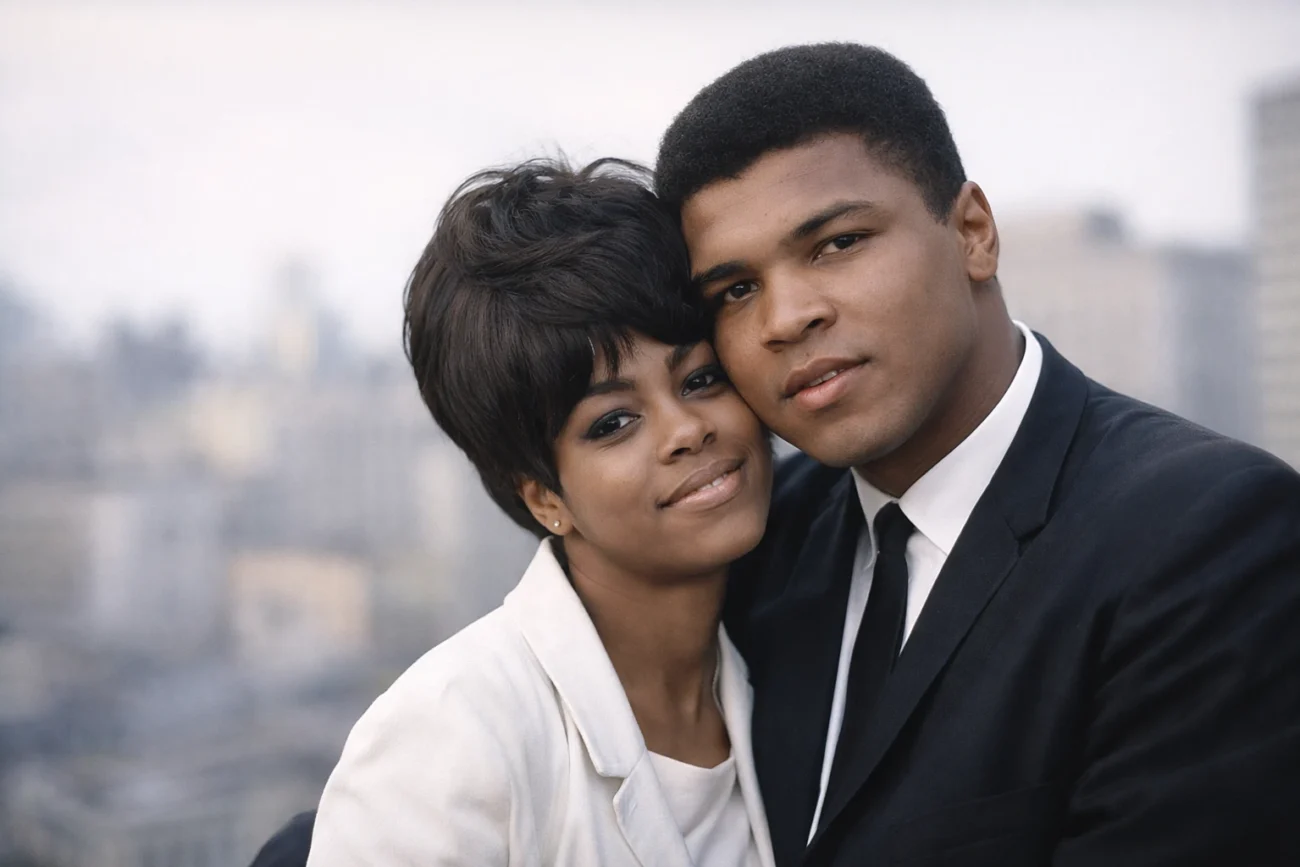
On August 14, 1964, in Gary, Indiana, a young woman named Sonji Roi stepped out of private life and into American celebrity history. She had married the heavyweight champion still widely known as Cassius Clay, just months after his stunning win over Sonny Liston and at the edge of the identity shift that would make him Muhammad Ali. One UPI photo caption from that day places the couple leaving a justice of the peace’s office, capturing the ordinary setting of a marriage that would be anything but ordinary. +1
Most people who search Sonji Roi are really asking two questions at once. The first is simple: who was she beyond being Muhammad Ali’s first wife. The second is harder: how much of her life can actually be known, given how thin and conflicting the public record remains. That second question matters, because Roi has been remembered in flashes, images, and secondhand retellings far more often than she has been documented in depth. +2NYTW’s The Brief+2
A careful biography of Sonji Roi has to begin with that imbalance. Her name stays alive because she was present at one of the most explosive moments in sports and cultural history, when Ali’s rise, religious commitment, and public reinvention were all happening at once. Yet the archive preserves her in fragments: a marriage date, a few press photos, a handful of music credits, two talk-show appearances, scattered genealogy entries, and an obituary trail that leaves just as much unsaid as it confirms. +3PBS+3PBS+3
What can be said with confidence
The core outline is secure. Sonji Roi was Muhammad Ali’s first wife, and public records consistently place their wedding on August 14, 1964, in Gary, Indiana. Those same records agree that the marriage ended in 1966, and that Roi died in Chicago on October 11, 2005. Databases tied to her entertainment work also show that she later appeared on The Mike Douglas Show and The Merv Griffin Show and released a small run of singles under the name Sonji Clay. +4Upi+4Find a Grave+4
Even those basics come with limits. IMDb, Discogs, and Find a Grave list her birth date as November 23, 1945, while FamilySearch and WikiTree identify her as Sonji Maria Roi, born November 23, 1948, in Brooklyn. That conflict is important because it runs through much of what is written about her online, where uncertain details are often repeated as settled fact. The safest account is the honest one: most entertainment and memorial databases lean toward 1945, while genealogy sources point to 1948. +4IMDb+4discogs.com+4
Early life and family
Publicly accessible records say very little about Sonji Roi’s childhood, schooling, or immediate family. FamilySearch places her birth in Brooklyn and later traces her to Chicago by the 1990s, while New York Theatre Workshop research, prepared for the play Fetch Clay, Make Man, says she lost her parents early and supported herself through nightclub work. Those details may well be true, but they do not sit on the same firm documentary footing as her marriage, public appearances, and death record. That gap is part of the story of Sonji Roi as much as any single fact about her. +1
What does emerge is a portrait of a young woman who was already making her own living before Ali entered the picture. The NYTW research note describes her as a cocktail waitress who had done some modeling, and that description is broadly echoed across later public profiles, even if many of those profiles add flourishes they cannot source. There is no strong public record showing elite schooling, inherited fame, or a family name that opened doors for her. She seems to have arrived in Ali’s orbit the old-fashioned way: by being visible, self-possessed, and working. +1
Meeting Cassius Clay
According to the most widely repeated and best-attributed account, Sonji Roi met Cassius Clay on July 3, 1964, and he proposed the same night. NYTW’s research post quotes her as saying, “I met him, and he asked me to marry him that night,” and states that the couple married 41 days later. However fast it happened in private, the public result is plain enough. A few weeks after meeting one of the most famous athletes in the country, Roi was standing beside him as his wife.
Timing made that relationship more charged than an ordinary whirlwind marriage. Clay had shocked the boxing world in February 1964 by beating Sonny Liston for the heavyweight title, and the months that followed were among the most closely watched of his life. PBS and HISTORY both frame that period as the hinge between the brash young champion called Cassius Clay and the global figure who would insist on the name Muhammad Ali. Roi did not marry a settled public figure; she married a man in the middle of becoming one. +3HISTORY+3PBS+3
A marriage caught between fame and faith
For a time, Sonji Roi was clearly part of Ali’s public image. Getty’s archival listings place the couple at Logan Airport in Boston in September 1964 and again together in Boston in November that year. Another Getty caption shows Roi in the stands during the May 25, 1965, Ali-Liston fight in Lewiston, Maine. These are small pieces of evidence, but they matter because they show that she was not hidden away; she was visibly there, in the frame, as Ali’s fame widened. +2Getty Images+2
The pressure on the marriage came from more than celebrity. NYTW’s account says the couple divorced amid conflict over Ali’s increasing devotion to the Nation of Islam, and later reporting preserved in an Associated Press snippet describes the split in similar terms. In popular retellings, this often gets reduced to clothes, lipstick, or whether Roi would follow strict rules about dress and conduct. The deeper truth is that Ali’s private life was being reorganized by faith, discipline, and male authority at extraordinary speed, and Roi did not fit easily into that new order. +1
By the summer of 1965, the marriage appears to have been badly frayed. A Getty caption from June 26, 1965, describes Roi as separated from her husband, and genealogy records place the formal divorce in early January 1966 in Dade County, Florida. That sequence fits the larger public record: a fast marriage in 1964, strain through 1965, and a legal ending in 1966. The whole union lasted roughly a year and a half, but it has endured in memory because of where it sat in Ali’s story. +2WikiTree+2
After Ali: music and television
Roi did not vanish after the divorce, even if later biographical writing sometimes treats her that way. Discogs lists three Sonji Clay singles released between 1966 and 1969: “Deeper In My Heart / What Now My Love?” in 1966, then “Here I Am And Here I’ll Stay / Nobody” and “I Can’t Wait (Until I See My Baby’s Face)” in 1969. This was not a major recording career, and there is no evidence that she broke through commercially. Still, the records are real, and they show an effort to build a public identity beyond the short marriage that made her famous. +1
Her television appearances tell a similar story. IMDb’s episode records show Sonji Clay appearing on The Mike Douglas Show on February 8, 1966, and Sonji Roi appearing on The Merv Griffin Show on February 2, 1966, where she was billed as “the former Mrs. Cassius Clay.” The billing is revealing. Even when she stepped onto television as a guest in her own right, the marketable angle was still her link to Ali. +1
That pattern has shaped her biography ever since. Roi’s own work survives mostly as supporting evidence in someone else’s legend, rather than as a record the public learned to follow for its own sake. Yet those music and TV credits complicate the easy version of her life, the one that says she flashed into history and disappeared. She did try to make a second act for herself, even if it remained modest and unevenly documented. +2IMDb+2
Marriage, children, and money after the spotlight
Later-life biographical claims about Sonji Roi need especially careful handling. Find a Grave identifies her as Sonji Roi Glover and says she later married attorney Reynaldo Preston Glover. But the Congressional Record tribute delivered after Reynaldo Glover’s death in 2007 names his wife as Pamela and lists their children, which suggests that whatever connection Sonji had to Glover, it was not the final marital arrangement reflected in his public memorial. That does not disprove a marriage, but it does show why tidy online summaries often outpace the record. +1
The same caution applies to claims about children and wealth. Many celebrity biography sites say Roi had one or two sons and assign her a net worth, but those claims usually arrive without court records, estate filings, interviews, or contemporary reporting to back them up. In the accessible public record, there is no reliable financial document that supports the dollar figures now floating around search results. For a subject like Roi, saying “not publicly confirmed” is not evasive; it is the most responsible thing a writer can say. +1
Final years and death
By the end of her life, Sonji Roi seems to have been living far from the glare that once surrounded her. FamilySearch places her in Chicago in 1996 and again at the time of her death, while the Associated Press account preserved in later search results says her body was found in her Hyde Park home on Chicago’s South Side on October 11, 2005. The Cook County medical examiner’s office reportedly classified the death as natural causes, which meant no autopsy would be performed. A nephew told the Chicago Sun-Times he suspected a heart attack, but that remained family suspicion rather than an official ruling. +2BoxRec+2
Find a Grave lists her burial at Mount Glenwood Memory Gardens South in Glenwood, Illinois, and records her age as 59, which fits the 1945 birth year used by most memorial and entertainment databases. If the 1948 genealogy date is correct, she would have been younger. That unresolved difference may seem small, but it captures the larger truth of Sonji Roi’s biography. Even at the edges of life and death, the public record around her remains incomplete. +2FamilySearch+2
Public image and cultural afterlife
Sonji Roi has also survived in cultural memory through dramatization. In Michael Mann’s 2001 film Ali, Jada Pinkett Smith played Roi opposite Will Smith’s Muhammad Ali, and theater productions of Fetch Clay, Make Man have returned audiences to the world around the young champion before the Liston rematch. Those works are not archival sources, but they help explain why Roi’s name keeps resurfacing for people who were not alive during her marriage. She remains part of the Ali story that film and stage continue to retell. +2Cinemablend+2
What’s surprising is how much sharper the dramatic image can feel than the documentary one. On screen and on stage, Sonji Roi often appears as a symbol of glamour, independence, temptation, or resistance at a turning point in Ali’s life. In the actual archive, she is harder to pin down and more interesting for that very reason. The gap between those two versions says a lot about how women near famous men are remembered: vividly, repeatedly, and often without enough of their own words on the record. +2Center Theatre Group+2
Why Sonji Roi still matters
Sonji Roi matters because she stood close to a public transformation that historians still study and audiences still replay. Ali’s 1964 shift from Cassius Clay to Muhammad Ali was not only a sports story; it was a collision of race, religion, masculinity, media, and American power. Roi’s brief marriage lets readers see what that collision looked like at household range. Through her, the legend comes back down to earth and becomes a story about pressure inside a marriage, not just headlines outside it. +2PBS+2
She also matters because the record around her shows how easily a woman can be flattened by history. Sonji Roi has been described, photographed, dramatized, and searched for far more often than she has been carefully reported on. But the fragments that do survive point to a woman who worked, moved on, sang a little, appeared on television, and refused to be entirely folded into someone else’s doctrine. That may not be the giant biography many readers expect, but it is a real life, and it deserves to be treated like one. +3NYTW’s The Brief+3discogs.com+3
Frequently Asked Questions
Who was Sonji Roi?
Sonji Roi was Muhammad Ali’s first wife, and she is also recorded in public sources as Sonji Clay and Sonji Roi Glover. She married Ali in Gary, Indiana, on August 14, 1964, during the turbulent period when he was moving from Cassius Clay to Muhammad Ali in public life. Outside that marriage, the record shows that she worked as a cocktail waitress, had some modeling experience, released a few singles, and appeared on television in 1966. +4Upi+4NYTW’s The Brief+4
When did Sonji Roi marry Muhammad Ali?
Public records consistently place the wedding on August 14, 1964, in Gary, Indiana. A UPI caption describes the couple after leaving a justice of the peace’s office, and later research from New York Theatre Workshop says they had met only 41 days earlier. That quick timeline is one reason the marriage still attracts so much attention. +1
Why did Sonji Roi and Muhammad Ali divorce?
The broad public answer is that the marriage broke under the strain of Ali’s increasing commitment to the Nation of Islam and the expectations that came with it. NYTW’s research note and later Associated Press reporting both point to conflict over Ali’s religious life and the demands placed on Roi inside that shift. The divorce was formalized in 1966 after a separation that seems to have been visible by mid-1965. +2BoxRec+2
Did Sonji Roi have children?
Some online biographies say she had children, but the strongest publicly accessible sources do not confirm those claims cleanly. The open record around her later family life is thin, and it becomes more confusing because memorial sources link her to Reynaldo Glover while his later public obituary names another wife, Pamela, and lists children in that household. The safest answer is that reports about Roi’s children exist online, but they are not well documented in reliable public sources. +2GovInfo+2
What did Sonji Roi do after divorcing Ali?
After the divorce, Roi pursued a brief entertainment career. Discogs lists three singles released under the name Sonji Clay between 1966 and 1969, and IMDb records appearances on The Mike Douglas Show and The Merv Griffin Show in February 1966. Those credits suggest an effort to move forward publicly, even if she never built a large mainstream career. +2IMDb+2
How did Sonji Roi die?
Sonji Roi died on October 11, 2005, in Chicago. Reporting preserved from the Associated Press says her body was found in her Hyde Park home and that the medical examiner treated the death as natural causes, so no autopsy was performed. A nephew suggested she may have suffered a heart attack, but that was never presented as the official cause of death. +2Legit.ng – Nigeria news.+2
What was Sonji Roi’s net worth?
There is no reliable public net-worth figure for Sonji Roi that rests on strong sourcing. Celebrity-profile websites do publish estimates, but those numbers typically appear without financial records, estate documents, or serious reporting behind them. Given how limited the accessible record is around her later life and income, any precise number should be treated with skepticism. +1
Conclusion
The story of Sonji Roi is smaller than the internet often promises, but it is sharper for that reason. She was not a mythic lost star waiting to be rediscovered, and the public record does not support turning her into one. She was a real woman who crossed paths with history at full speed and was changed by it. +1
Her biography also shows the cost of proximity to greatness. Ali’s rise has been studied from every angle, yet the people who lived beside that rise can vanish into labels like “first wife” unless someone stops to ask what can actually be known about them. In Roi’s case, that question leads to a portrait built from fragments, but the fragments still hold. +2PBS+2
That is why Sonji Roi still matters. She reminds readers that history does not only belong to the loudest voice or the biggest career. Sometimes it survives in a short marriage, a few songs, a handful of photographs, and the stubborn fact that someone’s life was larger than the role history assigned her. +3discogs.com+3IMDb+3
